Strategically located along the coast of the Chicama Valley, the El Brujo archaeological complex is a site of immense historical value within Peru’s cultural heritage. This site was occupied by different human groups over a period of approximately 14,000 years, leaving behind an extraordinarily rich archaeological record for the study of the pre-Hispanic past.
Today, the Wiese Foundation is responsible for overseeing its research, conservation, and enhancement through a formal partnership with Peru’s Ministry of Culture that spans more than 35 years. Thanks to this sustained commitment, specialists are able to continue uncovering and sharing evidence from the longest continuous chronological sequence on Peru’s coast.
In this article, we explore what archaeological research at the El Brujo complex entails.
What is Archaeological Research?
Research is a systematic process that allows us to generate knowledge, beginning with the identification of a problem and followed by the search for solutions. Within the social sciences, archaeology holds a unique place, as it studies past societies through the analysis of their material remains.
Archaeologists face a dual challenge: on one hand, they must reconstruct the complexity of societies that no longer exist; on the other, they must extract as much information as possible from often fragile remains.
This process is essential for understanding the evolution of the societies that inhabited what is now Peru, particularly in culturally rich contexts such as the northern coastal region.
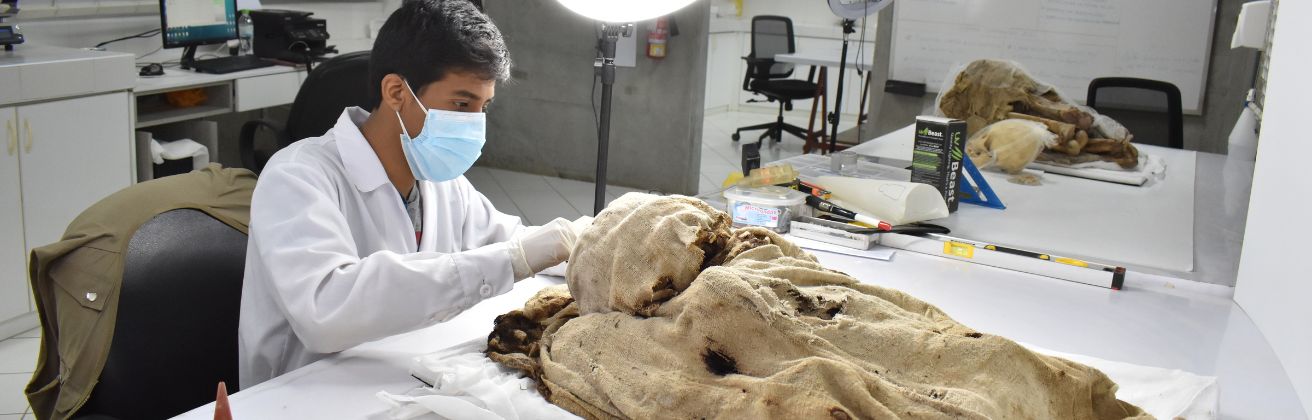
A key aspect of archaeological work is the careful exposure and documentation of contexts - defined as the location and arrangement of objects uncovered during excavation. This practice is essential for identifying past social activities. Additionally, analyzing how contexts overlap allows researchers to establish a chronological sequence of events and better understand the past. Finally, recurring patterns in objects and contexts reveal the behavioral patterns of ancient societies.
These practices are fundamental not only for generating knowledge, but also for the proper conservation and management of cultural heritage.

The General Protocol for Archaeological Research
To ensure optimal data recovery in the field and its subsequent analysis in the laboratory, archaeological research requires standardized criteria and procedures. In response to this need, the Wiese Foundation has implemented a General Archaeological Research Protocol.
This protocol is essential because it defines key areas of action and ensures consistent methodological guidelines across all interventions carried out at the El Brujo archaeological complex under the Foundation’s leadership.
This approach strengthens the quality of research and consolidates the site as a leading reference for archaeological studies on Peru’s northern coast.

Research Areas
Several key research areas have also been established, ranging from the analysis of funerary evidence to the management of natural resources and the production of objects.
These approaches are essential for gaining a deeper understanding of the ways of life of ancient societies, and they emphasize the importance of establishing precise chronologies, often obtained through radiocarbon dating techniques.
These studies have significantly contributed to our understanding of cultures such as the Moche, as well as to the documentation and systematization of important archaeological findings in Peru.

Collaborative Work
In order to promote cutting-edge research, the Wiese Foundation has carried out collaborative projects with leading academic institutions and researchers, both nationally and internationally.
This strategy has had a significant impact, enabling improved results through the development of new methodologies and the application of technological innovations. These contributions are essential for achieving a deeper understanding of Andean societies over time.
At the same time, this collaborative approach strengthens archaeological research in Peru and supports the sustainable management of cultural heritage.

In this way, the Wiese Foundation reaffirms its commitment to enriching our understanding of the women and men who inhabited ancient Peru. This is achieved both through participation in academic forums and through the active sharing of knowledge with the broader public.
Frequently Asked Questions About Archaeological Research in Peru and El Brujo
What is archaeological research in Peru?
Archaeological research in Peru is a scientific process that seeks to understand how past societies lived through the study of their material remains. Using rigorous methodologies—such as excavation, context recording, and laboratory analysis—specialists reconstruct the history of ancient populations in the region.
This work is essential for generating knowledge about the past, strengthening cultural identity, and contributing to the proper management of Peru’s cultural heritage.
What is studied at El Brujo?
At the El Brujo archaeological complex, researchers study various aspects of the societies that inhabited Peru’s northern coast over thousands of years. Research areas include funerary contexts, object production, spatial organization, and the management of natural resources.
These studies have deepened our understanding of cultures such as the Moche and have helped document and systematize important archaeological findings that shed light on the country’s historical processes.
What role does the Wiese Foundation play in research?
The Wiese Foundation plays a central role in archaeological research in Peru through its work at the El Brujo archaeological complex. For more than 35 years, it has led efforts in research, conservation, enhancement, and the social use of the site, in partnership with the Ministry of Culture.
Through the implementation of specialized protocols, the promotion of collaborative projects, and the sharing of knowledge, the Foundation contributes to high-quality research and brings this knowledge closer to society.


