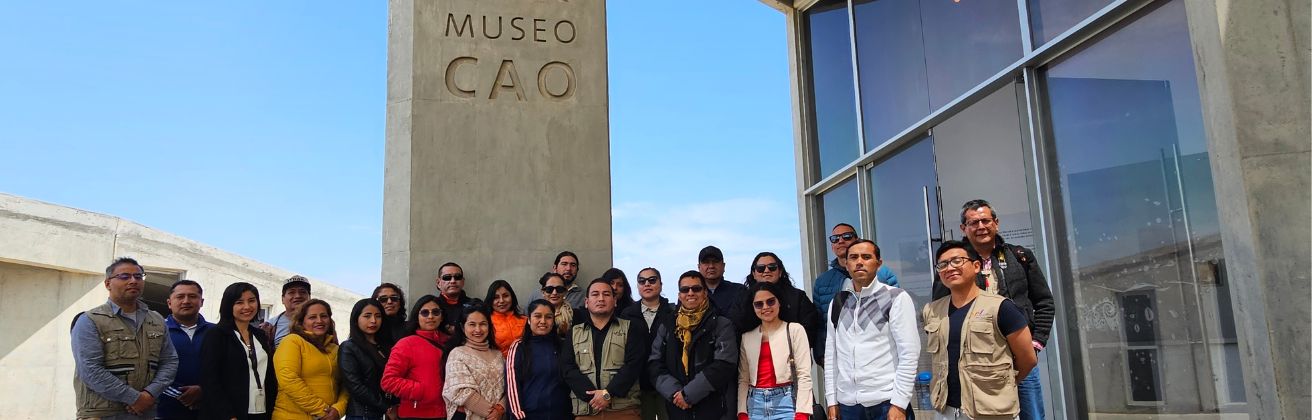
As part of the Cultural Plan for Magdalena de Cao and Its Annexes – October 2025, the Wiese Foundation successfully carried out the “Specialized Training for Tourism Professionals and Operators,” held on October 27 at the El Brujo Archaeological Complex (CAEB) and in various locations throughout the district of Magdalena de Cao.
The event brought together 22 tourism professionals and operators from Trujillo and Lambayeque, who strengthened their knowledge of cultural heritage management, archaeological research, and the development of sustainable and inclusive tourism.

During the training, participants attended specialized talks led by the CAEB team of archaeologists and research specialists, who presented the latest advances in archaeological research at the site. Guided visits to the archaeological laboratory and artifact storage areas were also conducted.

In addition, creative workshops and awareness-raising activities were held, aimed at strengthening the connection between tourism and heritage conservation.

The day concluded with a tour of the district of Magdalena de Cao, where participants visited local enterprises, artistic murals, and artisans’ workshops, recognizing the valuable work of the community and its contribution to the development of cultural tourism in the area.

What is the Magdalena de Cao Cultural Plan?
The Magdalena de Cao Cultural Plan seeks to raise awareness among the local population about the importance of knowing, valuing, and preserving their cultural heritage.
For several years, archaeologists, conservators, educators, communicators, and community tourism specialists from the Wiese Foundation have worked in an interdisciplinary manner so that every resident of Magdalena de Cao recognizes themselves as an heir to a millennia-old history that deserves to be protected and shared. The year 2025 has been no exception.
Designed in a variety of formats—such as workshops, exhibitions, guided visits, discussion forums, artistic interventions, and more—the activities of the Cultural Plan’s annual program engage children, teachers, small entrepreneurs, and artisans, among other members of the local community, including those living in the district’s smallest annexes. Through this plan, the Wiese Foundation has the opportunity to listen to the community’s voices and strengthen collaborative ties.
With this initiative, the Wiese Foundation reaffirms its commitment to education, culture, and the sustainable development of communities, promoting the social use of archaeological heritage and collaborative work with local stakeholders in tourism management.
Learn more at: www.fundacionwiese.org


